

Infrastructure Sustainability – what is it?
Infrastructure sustainability is about balancing triple bottom line trade-offs, and extends beyond just addressing ecological concerns. However, it is “not simply a matter of trading off positive impacts in one area against negative impacts in another. A successful development builds on the three pillars and achieves economic success, social benefit and high environmental quality together”.
The Royal Academy of Engineering (2005) Engineering for Sustainable Development: Guiding Principles, London.
MJC Sustainability has had a long association with the pursuit of sustainable outcomes from complex infrastructure projects. Finally in Australia, we have a robust rating tool specifically for Infrastructure Sustainability. The rating tool developed and administrated by the Infrastructure Sustainability Council of Australia is the first and only tool of its kind in Australia. The structure and certification levels have some similarities with other rating tools, for example GreenStar, BREEAM and LEED. You can find all the details here.
The ISCA rating tool:
◾Provides a common national language for sustainability in infrastructure
◾Provides a vehicle for consistent application and evaluation of sustainability in tendering processes
◾Facilitates scoping whole-of-life sustainability risks for projects and assets, enabling smarter solutions that reduce risks and costs
◾Fosters resource efficiency and waste reduction, reducing costs
◾Fosters innovation and continuous improvement in the sustainability outcomes from infrastructure
◾Builds an organisation’s credentials and reputation in its approach to sustainability in infrastructure
MJC Sustainability is now accredited to apply the rating tool and lead your project through the process to attain certification.
Why you need to pursue it NOW
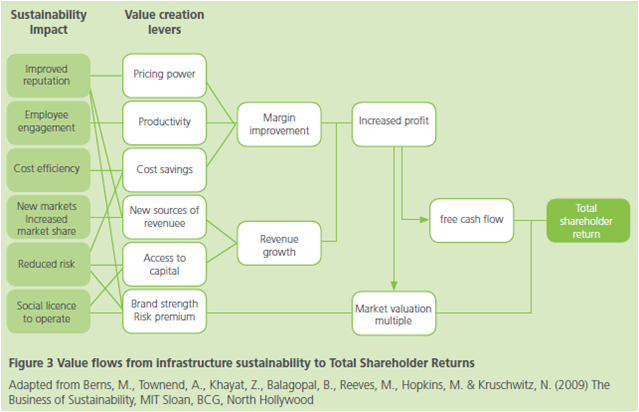
Most organisations have an imperative to create value and deliver returns to shareholders. In the case of government agencies, the drivers are more about effective use of tax payer funds.
This work by MIT shows how all the different value creation levers relate back ultimately to shareholder returns.
The varied projects that have already applied the rating tool and attained a level of certification, either during the design or construction phase, have reported the following benefits: